

 Español
Content
- 1 1. Executive Overview and Structural Fundamentals
- 2 2. Primary Material Specifications: Steel, Polyethylene, Polyurethane, and Rubber
- 3 3. Core Material Performance Comparison Matrix
- 4 4. Structural Mounting Options: Surface Mount, In-Ground Core, Removable, and Automatic Retractable
- 5 5. Flexible Spring-Back vs Rigid Impact Bollards: Operational Performance Dynamics
- 6 6. Crash Ratings and Impact Resistance Standards
- 7 7. Visibility Features: Reflective Sheeting, Color Permeation, and LED Integration
- 8 8. Commercial Application Matrix: Facility Zone Requirements
- 9 9. Cost Analysis, Maintenance Requirements, and Life-Cycle Value
- 10 10. Master Comparison Matrix for Warning Traffic Bollard Selection
- 11 11. Frequently Asked Questions (FAQ)
- 11.1 FAQ 1: What is the primary difference between a traffic delineator post and a warning traffic bollard?
- 11.2 FAQ 2: How deep must an in-ground core steel warning bollard be installed in concrete?
- 11.3 FAQ 3: Which warning traffic bollard material performs best in sub-zero freezing climates?
- 11.4 FAQ 4: How are reflective bands secured to warning bollards to ensure long-term visibility?
- 11.5 FAQ 5: Can surface-mount base plate bollards be mounted directly onto asphalt surfaces?
- 12 12. Key Standards and Engineering References
1. Executive Overview and Structural Fundamentals
Warning traffic bollards serve as essential physical and visual safety assets across municipal, commercial, and industrial sites. Their primary function is to direct vehicular traffic flow, establish clear perimeter boundaries, protect pedestrian walkways, and shield critical building infrastructure from vehicle collisions. Selecting the appropriate warning traffic bollard requires evaluating multiple technical parameters, including material properties, mounting mechanisms, impact energy absorption, environmental endurance, and visibility standards.
This technical procurement guide analyzes the core engineering specifications, material options, and mounting configurations of warning traffic bollards. Designed for facility managers, municipal engineers, traffic safety contractors, and international B2B distributors, this document evaluates how different bollard designs perform across various real-world commercial and industrial environments.
2. Primary Material Specifications: Steel, Polyethylene, Polyurethane, and Rubber
The structural material of a warning traffic bollard dictates its physical stopping power, weather resistance, collision response, and long-term maintenance requirements. Four primary materials dominate the commercial traffic safety industry.
Carbon Steel and Stainless Steel Bollards
Steel warning bollards provide maximum structural stopping resistance. Carbon steel posts are hot-dip galvanized and finished with outdoor thermosetting powder coatings to resist rust, moisture, and chemical exposure. Grade 304 and 316 stainless steel bollards deliver elevated corrosion resistance and a refined metallic appearance suitable for corporate headquarters, transit hubs, and architectural plazas. When hit by a vehicle, steel bollards absorb kinetic energy through rigid structural resistance, stopping forward vehicle momentum. However, severe impacts permanently deform steel posts, requiring concrete excavation and full replacement.
High-Density Polyethylene (HDPE) Bollards
Polyethylene warning bollards are lightweight, rustproof, and chemical-resistant. Color pigments are integrated throughout the polymer during rotational molding or extrusion, ensuring HDPE bollards never require repainting and will not chip, peel, or rust when scraped. They perform effectively in harsh environmental settings exposed to moisture, deicing salts, or industrial chemicals, such as coastal facilities, chemical storage areas, and car wash bays.
Polyurethane (PU) Flexible Bollards
Polyurethane is an advanced elastomeric polymer known for high tensile strength and elastic memory. Polyurethane warning bollards are engineered to flex up to 90 degrees upon impact from a vehicle and automatically return to their upright vertical orientation without permanent structural damage. This self-recovery mechanism eliminates maintenance intervention in high-frequency, low-speed collision zones such as toll plazas, lane merging points, and tight parking garage turns.
Recycled Rubber and Synthetic Elastomer Bollards
Rubber bollards are manufactured from vulcanized synthetic rubber or recycled tire compounds. Rubber posts compress and flex upon contact, absorbing low-speed impact forces while minimizing physical damage to colliding vehicles and equipment. They are well-suited for industrial distribution hubs, factory aisles, and loading dock approaches where forklift scrapes and equipment contact occur regularly.
3. Core Material Performance Comparison Matrix
The matrix below compares the structural, environmental, and operational characteristics of the four primary bollard materials.
| Material Type | Primary Barrier Strength | Collision Response Dynamics | Weathering and UV Resistance | Ideal Operational Environment |
|---|---|---|---|---|
| Carbon Steel / Stainless Steel | Maximum structural resistance | Rigid stopping force; deforms under heavy impact | Excellent with hot-dip galvanizing or powder coat | High-security zones, storefronts, building perimeters |
| High-Density Polyethylene (HDPE) | Low to moderate physical resistance | Semi-rigid; deforms slightly without shattering | Corrosion-proof; high UV stability | Parking lots, chemical plants, wash-down bays |
| Polyurethane (PU) | Low stopping force; high guidance value | Full 360-degree rebound; self-recovers immediately | Weather-resistant; color permeated throughout | Highways, lane dividers, toll plazas, sharp turns |
| Recycled Rubber / Elastomer | Low to moderate energy absorption | Compresses and bends; minimizes vehicle damage | Moisture-proof; resistant to heavy equipment scrapes | Loading docks, logistics centers, industrial aisles |
4. Structural Mounting Options: Surface Mount, In-Ground Core, Removable, and Automatic Retractable
Selecting the proper mounting mechanism depends on whether the installation requires permanent perimeter protection, surface-level visual guidance, or dynamic access control.
Surface-Mount Base Plate Bollards
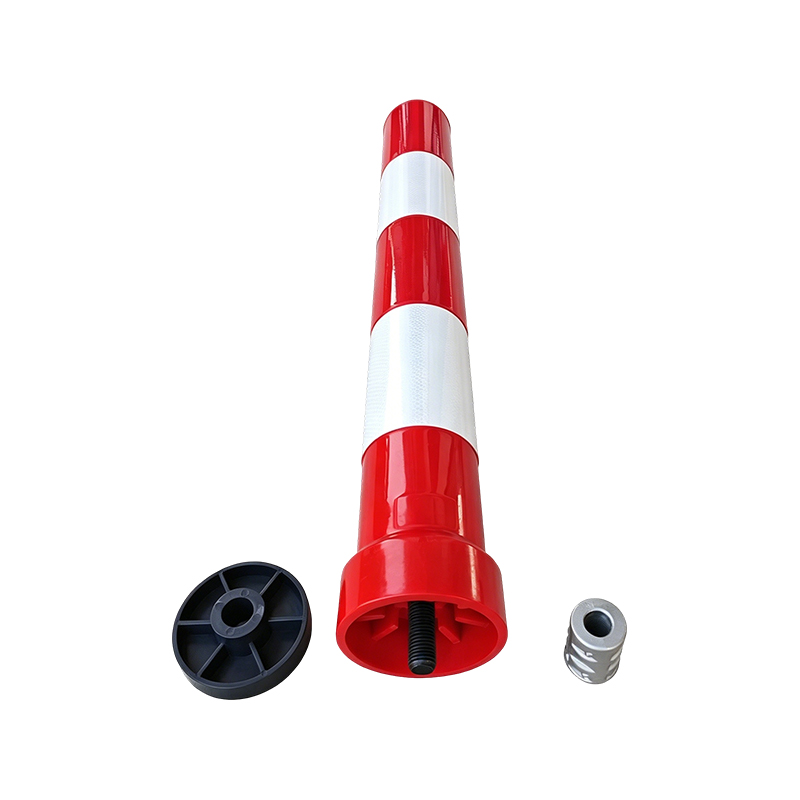
Surface-mount warning bollards feature a welded steel or molded base plate anchored directly onto existing concrete slabs or paved surfaces using heavy-duty expansion anchor bolts or chemical epoxy anchors.
The primary advantage is rapid installation without deep excavation, minimizing site disruption and lowering labor costs. However, overall holding capacity is limited by the shear strength of the concrete surface. Surface-mount bollards are designed for visual guidance, traffic channelization, and low-speed physical delineation rather than stopping high-speed vehicle impacts. Typical applications include multi-level parking decks with shallow slab depths, warehouse aisles, and commercial sidewalk borders.
In-Ground Core-Embedded Bollards
Core-embedded bollards are installed deep into concrete foundations. Installation requires core drilling or trenching into the ground, positioning the steel post, and pouring reinforced concrete around and inside the pipe core.
The main benefit is structural barrier integrity, providing maximum stopping power against heavy vehicle impacts. The primary constraint is permanent placement, as relocating an in-ground post requires concrete cutting and heavy machinery. Typical applications include retail storefronts, utility transformer boundaries, fuel pump islands, and high-security building perimeters.
Removable Warning Bollards
Removable bollards fit into a permanently installed ground sleeve set flush with the road deck. When locked into position with an internal locking mechanism or padlock, the post serves as a stationary protective barrier. When vehicular access is required, site personnel unlock and manually lift the post out of the ground sleeve.
The primary advantage is flexible space management, creating temporary vehicle access lanes while leaving a flat ground surface when removed. The limitation is that manual lifting and dedicated post storage are required during open periods. Typical applications include emergency vehicle access paths, seasonal pedestrian arcades, event spaces, and delivery staging zones.
Automatic Retractable Bollards
Automatic bollards descend vertically into an underground casing flush with the pavement surface. Driven by pneumatic, hydraulic, or electro-mechanical actuators, these units integrate with electronic access control software, remote control transmitters, card readers, or automated license plate recognition systems.
The principal advantage is instant, automated access control without manual labor, maintaining heavy structural resistance when raised. The main constraints are higher initial capital cost and the need for scheduled preventative maintenance of drive components and underground drainage sumps. Typical applications include corporate driveways, restricted municipal street zones, transit hubs, and private commercial entrances.
5. Flexible Spring-Back vs Rigid Impact Bollards: Operational Performance Dynamics
Understanding the structural distinction between flexible delineator bollards and rigid impact barriers is critical when establishing site safety specifications.
| Performance Metric | Flexible Spring-Back Bollard | Rigid Structural Impact Bollard |
|---|---|---|
| Construction Material | Polyurethane, TPU, or Rubber composite base | Heavy-wall carbon steel or reinforced concrete core |
| Collision Mechanics | Flexes, absorbs force, and self-restores | Rigidly resists impact force to halt momentum |
| Vehicle Damage Risk | Minimal paint or body panel damage | High vehicular deformation upon impact |
| Post-Collision State | Remains functional and upright | May require structural repair or complete replacement |
| Primary Objective | Visual traffic guidance and lane separation | Physical asset and pedestrian perimeter protection |
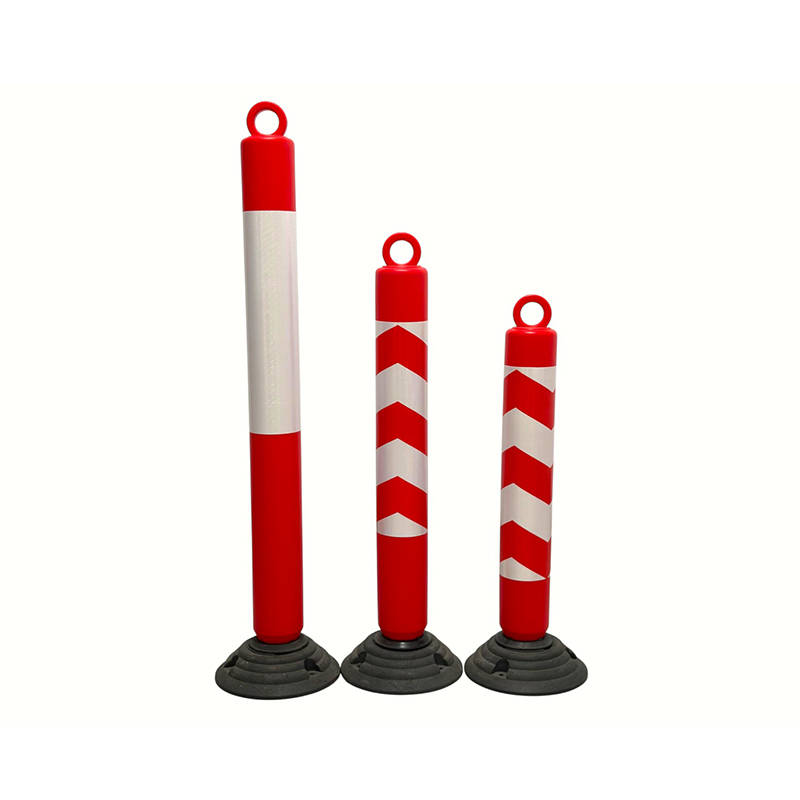
Flexible bollards function as guidance, warning, and lane separation markers. When a vehicle clips a flexible polyurethane post, the internal spring mechanism or elastomeric hinge absorbs the force, allowing the vehicle to pass over or brush past without sustaining major body damage. The post immediately rebounds to its vertical position, keeping traffic channels defined without requiring maintenance repairs.
Rigid bollards operate as physical stopping barriers. Constructed from structural steel pipes filled with concrete, rigid bollards do not yield during a collision. Instead, they absorb kinetic impact energy through structural resistance, halting vehicle momentum to protect pedestrians, building entrances, electrical transformers, and gas meters situated behind the installation line.
6. Crash Ratings and Impact Resistance Standards
In security-sensitive commercial locations or critical infrastructure boundaries, warning traffic bollards must comply with internationally recognized crash testing standards. These performance frameworks test a bollard system’s capability to halt a specific vehicle weight traveling at a designated velocity.
ASTM F2656 / F2656M Standard
The American Society for Testing and Materials ASTM F2656 standard evaluates vehicle security barriers using standardized test vehicles:
Medium-Duty Trucks utilize a test mass of 15,000 lbs (6,800 kg). Speed classifications include M30 for 30 mph (48 km/h), M40 for 40 mph (65 km/h), and M50 for 50 mph (80 km/h). Penetration metrics record how far the vehicle payload travels past the barrier line:
- P1 rating indicates penetration less than or equal to 3.3 feet (1.0 meter).
- P2 rating indicates penetration between 3.31 feet and 23.0 feet (1.01 to 7.0 meters).
- P3 rating indicates penetration greater than 23.1 feet (7.01 meters).
IWA 14-1 and PAS 68 Standards
International standard IWA 14-1 and British standard PAS 68 specify test requirements for vehicle security barriers. These frameworks test commercial vehicles weighing 16,500 lbs (7,500 kg) across speeds from 30 km/h to 80 km/h. Test reports document performance through vector indicators detailing impact angle, vehicle mass, test speed, and payload penetration distance.
| Rating Standard | Test Vehicle Mass | Impact Test Speed | Kinetic Energy Absorption Level |
|---|---|---|---|
| ASTM M30 / K4 Equivalent | 15,000 lbs (6,800 kg) | 30 mph (48 km/h) | Approximately 656 kilojoules |
| ASTM M40 / K8 Equivalent | 15,000 lbs (6,800 kg) | 40 mph (65 km/h) | Approximately 1,168 kilojoules |
| ASTM M50 / K12 Equivalent | 15,000 lbs (6,800 kg) | 50 mph (80 km/h) | Approximately 1,825 kilojoules |
| IWA 14-1 / PAS 68 | 16,500 lbs (7,500 kg) | 30 km/h to 80 km/h | Varies based on speed profile |
7. Visibility Features: Reflective Sheeting, Color Permeation, and LED Integration
A warning traffic bollard must remain conspicuous under all lighting and weather conditions to maximize reaction time for drivers and equipment operators.
High-Intensity Reflective Sheeting Bands
Warning bollards incorporate retroreflective microprismatic or glass-bead sheeting bands compliant with ASTM D4956 guidelines. Type IV High-Intensity Prismatic sheeting delivers clear retroreflective performance for municipal streets, parking lots, and industrial facilities. Type IX and XI Diamond Grade sheeting offers wide-angle reflectivity for unlit access roads, highway merge points, and hazardous industrial intersections.
High-Visibility Color Permeation
Standard commercial safety colors conform to international traffic safety codes:
- Safety Yellow indicates caution, physical hazard zones, machinery boundaries, and structural protection.
- High-Visibility Orange identifies temporary traffic control zones, construction sites, and detour channels.
- Safety Red marks emergency vehicle lanes, fire hydrants, and restricted security perimeters.
- Architectural Black and Stainless Steel blend into urban landscapes while utilizing reflective top bands for nighttime visibility.
Integrated LED Illumination
Modern smart warning bollards incorporate top-mounted or ring LED lighting modules. Photovoltaic solar LED bollards charge during daylight hours and automatically illuminate at dusk, eliminating subterranean electrical wiring costs. Direct-wired low-voltage LED bollards provide continuous illumination along pedestrian pathways, corporate driveways, and architectural walkways.
8. Commercial Application Matrix: Facility Zone Requirements
Selecting the correct warning traffic bollard involves matching product physical properties to specific commercial settings.
| Facility Application Zone | Recommended Material | Structural Mounting Mechanism | Key Functional Requirement |
|---|---|---|---|
| Retail Storefront Entrances | Heavy-wall Carbon Steel Pipe | In-Ground Core Embedded | Vehicle impact prevention and storefront protection |
| Highways and Toll Lanes | High-Flex Polyurethane | Base Plate / Concrete Anchors | 360-degree rebound memory and lane channelization |
| Commercial Parking Structures | HDPE / Powder-Coated Steel | Surface Mount Base Plate | Visual warning and perimeter delineation |
| Logistics Loading Docks | Heavy Rubber / Steel Composite | In-Ground Core or Heavy Surface | High-impact corner protection for loading bays |
| Pedestrian Plazas | Grade 304/316 Stainless Steel | Removable or Automatic Retractable | Flexible crowd control and temporary vehicle access |
Retail Storefronts and Commercial Center Entrances
Storefronts facing parking stalls require core-embedded heavy carbon steel bollards. Accidental pedal misapplications can propel vehicles over curbs and through glass storefronts. Deep-set structural steel barriers halt vehicle momentum, protecting patrons and interior assets.
Highways, Expressways, and Toll Plazas
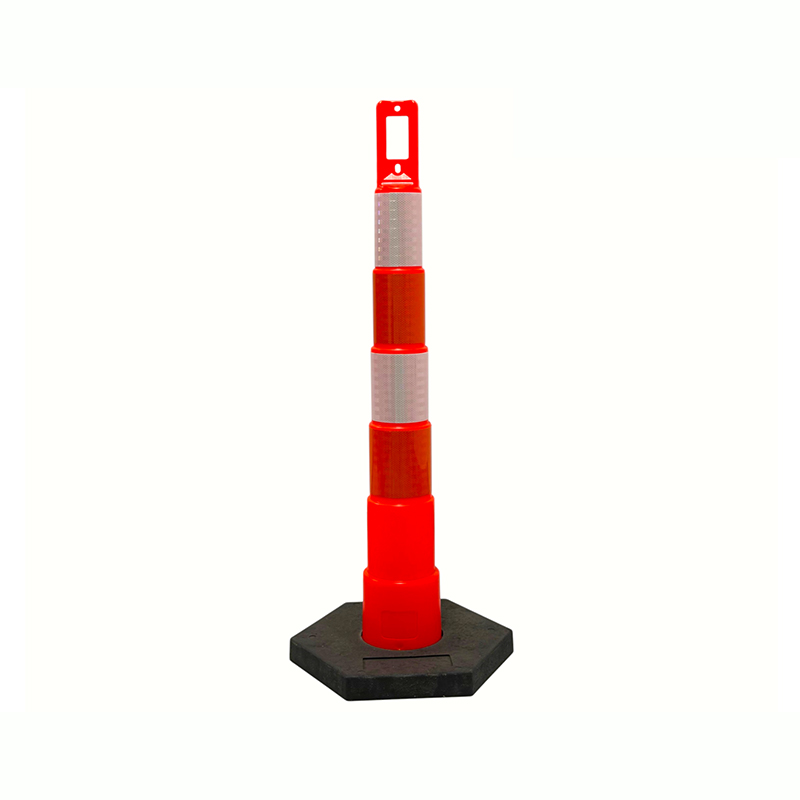
High-speed road networks require flexible polyurethane warning bollards with high-intensity prismatic reflective bands. These units withstand repeated vehicle contact without detaching from the road deck, keeping traffic channels defined without creating road hazards.
Warehouses and Logistics Distribution Centers
Indoor manufacturing plants, storage rack corners, and loading dock aprons benefit from bright safety yellow high-density polyethylene bollards or steel posts with elastomeric bases. Bright yellow coatings warn forklift drivers of structural hazards, while impact-absorbing materials protect floor slabs from cracking during low-speed equipment scrapes.
Commercial Parking Structures and Garages
Parking decks with shallow concrete slab depths require surface-mount base plate bollards or flexible polyurethane posts. These units outline turning boundaries, protect ramp walls, and mark pedestrian lanes without damaging embedded tension cables inside thin concrete slabs.
Pedestrian Plazas and Public Event Spaces
Pedestrian zones with periodic service vehicle traffic require stainless steel removable or automatic retractable bollards. These systems allow open access for foot traffic during business hours while permitting delivery trucks or emergency vehicles to enter when unlocked or lowered.
9. Cost Analysis, Maintenance Requirements, and Life-Cycle Value
Evaluating bollard specifications requires balancing initial purchase price, site preparation costs, and long-term maintenance overhead.
| Bollard System Type | Initial Capital Cost | Installation Expense | Scheduled Maintenance Need | Expected Operational Life |
|---|---|---|---|---|
| Surface-Mount HDPE | Low | Low | Minimal maintenance | 5 to 8 Years |
| Flexible Polyurethane Post | Moderate | Low | Very low maintenance | 7 to 10 Years |
| In-Ground Steel Core | Moderate to High | High | Periodic repainting / touch-up | 15 to 25 Years |
| Automatic Retractable System | High | Very High | Scheduled mechanical servicing | 10 to 15 Years |
Initial Hardware and Installation Expenses
Surface-mount bollards feature the lowest entry cost due to straightforward mechanical anchor bolt installation. In-ground core bollards incur higher installation expenses due to concrete cutting, excavation, rebar reinforcement, and concrete pouring. Automatic systems require control wiring, drainage installation, power connections, and drive unit integration, resulting in higher initial capital outlay.
Maintenance Requirements and Life-Cycle Costs
Polyurethane and HDPE bollards minimize life-cycle expenses. They do not rust, crumble, or require regular painting, making them cost-effective for high-traffic commercial spaces. Steel bollards require periodic inspection for surface scratches or powder coat breaches to prevent corrosion. Galvanized undercoats extend maintenance intervals significantly in outdoor environments. Automatic retractable bollards require routine servicing, including clearing ground sump drains, checking hydraulic fluid levels, inspecting seal integrity, and testing safety sensor loops.
10. Master Comparison Matrix for Warning Traffic Bollard Selection
The summary matrix below compares all major bollard categories across key performance metrics to assist with technical procurement decisions.
| Feature Category | Fixed Steel Core | Flexible PU Post | HDPE Base Plate | Automatic Retractable |
|---|---|---|---|---|
| Physical Barrier Strength | Maximum High | Low | Low to Moderate | High to Maximum |
| Visual Warning Value | High | Very High | High | Moderate to High |
| Vehicle Damage Risk | High | Minimal | Low | High |
| Installation Depth | Deep (24 to 48 in) | Surface Anchor | Surface Anchor | Deep Sump Casing |
| Rebound Capability | None | Full 360 Degree | Partial Flex | None |
| Corrosion Resistance | Medium to High | Excellent | Excellent | High (Stainless Steel) |
| Access Control Agility | Fixed Permanent | Fixed Permanent | Fixed Permanent | Dynamic Automated |
11. Frequently Asked Questions (FAQ)
FAQ 1: What is the primary difference between a traffic delineator post and a warning traffic bollard?
A traffic delineator post is a lightweight visual guide used to direct traffic flow and mark lane edges. Delineator posts are usually thin PVC or flexible plastic tubes designed to bend or snap upon impact without resisting vehicle movement. A warning traffic bollard is a sturdier safety structure. While some bollards are made flexible for lane division, warning bollards generally feature larger diameters, thicker wall dimensions, higher visual presence, and, in rigid steel configurations, structural strength designed to stop or divert moving vehicles.
FAQ 2: How deep must an in-ground core steel warning bollard be installed in concrete?
Standard commercial installations require embedding one-third to one-half of the post’s total length underground. For standard protection against low-speed vehicles, an embedded depth of 24 inches (600 mm) to 36 inches (900 mm) set in reinforced concrete is typical. For certified crash-rated barriers meeting ASTM M30 or M50 standards, foundation depths range from 36 inches to 48 inches or deeper, supported by continuous concrete footings and rebar cages.
FAQ 3: Which warning traffic bollard material performs best in sub-zero freezing climates?
Polyurethane and high-density polyethylene bollards, along with hot-dip galvanized steel bollards, perform well in freezing environments. Flexible polyurethane maintains its elasticity and memory rebound down to -40 degrees Celsius without cracking. Hot-dip galvanized carbon steel and stainless steel resist corrosion caused by road salts and deicing chemicals. For removable or retractable bollards installed in freezing regions, ground drainage sumps must be cleared to prevent water collection and ice buildup inside sleeves.
FAQ 4: How are reflective bands secured to warning bollards to ensure long-term visibility?
Reflective bands are placed around the upper section of the bollard post to provide 360-degree visibility. Compliance standard ASTM D4956 specifies required retroreflective performance levels. On flexible polyurethane and plastic bollards, high-intensity prismatic sheeting is recessed into molded grooves to prevent edges from peeling during impacts. On steel bollards, retroreflective tape is applied to clean, smooth powder-coated surfaces or fitted into machined channels for long-term adhesion.
FAQ 5: Can surface-mount base plate bollards be mounted directly onto asphalt surfaces?
Mounting surface-mount base plate bollards directly onto asphalt using expansion anchor bolts is not recommended. Asphalt is softer and less dense than concrete, causing anchor bolts to pull free under minimal lateral force. To install surface-mount bollards on asphalt roads or parking lots, installers should pour concrete footings beneath the asphalt surface or use specialized asphalt anchor rods secured with structural epoxy resins.
12. Key Standards and Engineering References
- ASTM F2656/F2656M: Standard Test Method for Performance of Vehicle Security Barriers. American Society for Testing and Materials.
- Manual on Uniform Traffic Control Devices (MUTCD), Part 6: Temporary Traffic Control and Channelizing Devices. Federal Highway Administration (FHWA).
- EN 12899-1: Fixed, Vertical Road Traffic Signs and Retroreflective Warning Delineators. European Committee for Standardization.
- PAS 68 / IWA 14-1: Impact Testing Specifications for Vehicle Security Barriers. British Standards Institution / International Workshop Agreement.
- ASTM D4956: Standard Specification for Retroreflective Sheeting for Traffic Control. American Society for Testing and Materials.