

 Español
Content
- 1 What Happens When a Freight Truck Runs Over a Cone?
- 2 PVC Traffic Cones: Stiffness With a Rebound Limit
- 3 Rubber Traffic Cones: Heavy-Duty Recovery Champion
- 4 PE (Polyethylene) Traffic Cones: The Balanced Workhorse
- 5 Head-to-Head Comparison Under Truck Overruns
- 6 Beyond Material: What Else Determines Survival?
- 7 Which Cone Should You Choose for Heavy Truck Zones?
- 8 Frequently Asked Questions
Traffic cones are deliberately placed in the path of heavy freight trucks. In highway work zones, distribution yards, and warehouse loading areas, a fully loaded truck can weigh up to 36,000 kg. When a tire rolls over a cone, the material must do something most products are not designed to do: absorb the full static and dynamic load of a multi-ton vehicle, recover its shape, and keep guiding traffic moments later.
Three materials dominate the market: PVC, rubber, and polyethylene (PE). Each has a different molecular structure, stiffness, and memory behavior. This article compares them specifically under the extreme condition of heavy freight truck overruns, so you can choose the cone that survives the longest where it matters most.
Quick answer: rubber survives daily heavy truck overruns best, PE offers the best balance of weight, cost, and rebound, and PVC remains a budget choice for low-impact zones.
What Happens When a Freight Truck Runs Over a Cone?
The worst-case scenario is not a slow roll-over. It is a loaded trailer tire hitting the cone near the base while the truck is turning or changing lanes. The cone receives three simultaneous forces:
- Vertical crushing force from the tire footprint that compresses the cone body against the asphalt.
- Lateral shear as the tire pushes the cone sideways and twists it against the pavement.
- Dynamic shock from vehicle speed, which multiplies the effective load.
Materials fail in different ways. Rigid plastics crack and split. Soft materials deform permanently or tear away from the base. The ideal cone flexes enough to let the tire pass, then returns almost instantly to its original geometry.
PVC Traffic Cones: Stiffness With a Rebound Limit
Polyvinyl chloride (PVC) cones are common because they are inexpensive to mold and accept bright colors and reflective collars well. Standard PVC is stiff, so cones hold their shape in summer heat without sagging. In high-elasticity formulations, the body can bend significantly under a truck tire and spring back when the load is removed.
However, PVC has a clear limit under repeated overruns. A single smooth roll-over may leave an elastic PVC cone nearly unchanged, but a loaded truck turning on a cone will often crack the thin wall near the base. Cold weather worsens it: unmodified PVC becomes brittle below roughly 0°C and can shatter on impact.
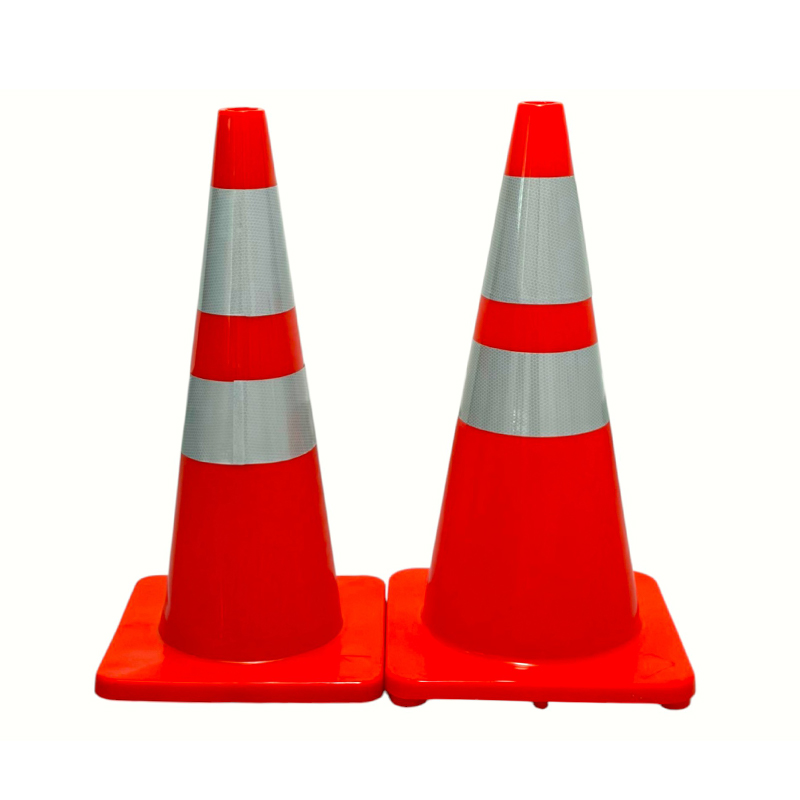
 High-Elasticity PVC Traffic Safety Cone with Optional Weighted Rubber Base for All-WeatherHigh-Flexibility PVC Material: One-piece molded from premium PVC, offering excellent toughness and impact resistance; it quickly regains its original shape even after ...View Product →
Key advantages
- Lightweight and easy to deploy by hand.
- Excellent colour retention and UV resistance.
- High-elasticity grades recover well from occasional overruns.
Limitations under truck loads
- Can crack or split at the base after repeated heavy impacts.
- Becomes brittle in freezing temperatures.
- Not ideal for zones where trucks overrun cones daily.
Rubber Traffic Cones: Heavy-Duty Recovery Champion
Rubber cones are the traditional answer to truck overruns. They are dense, flexible, and extremely tear-resistant. When a loaded truck tire rolls over rubber, the material compresses under the footprint and then pushes back to its original shape. Rubber also absorbs vibration, so the cone is less likely to be thrown or dragged by a turning tire.
The trade-off is weight and cost. A rubber cone at the same height as a plastic cone typically weighs two to three times more, which slows down crews that set up and recover cones by hand. They cost more upfront, and non-UV-stabilized rubber can fade over time. Still, in zones where cones are overrun daily, rubber is the material most likely to remain standing.
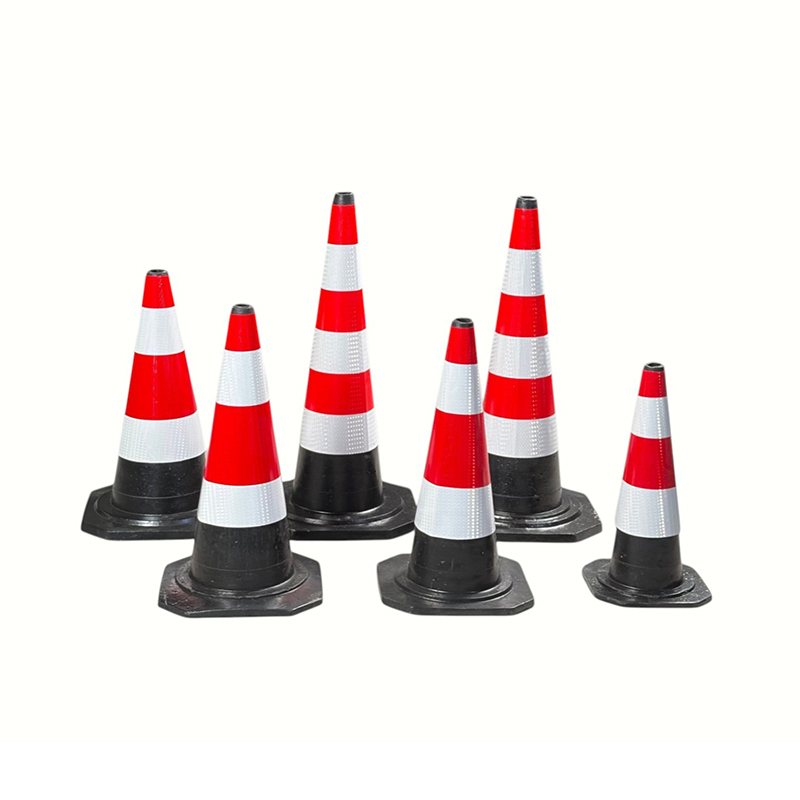
 Multiple Sizes Industrial Heavy-Duty Rubber Traffic Cone for Cost-Effective Road Safety SoAnti-Crush Durable Design: Made from high-quality synthetic rubber with extreme flexibility. It can withstand repeated heavy vehicle compression and quickly regain its...View Product →
Key advantages
- Highest resistance to crushing and splitting.
- Excellent rebound after repeated loads.
- Stable in high winds because of its mass.
Limitations under truck loads
- Heavy to carry, store, and deploy.
- Higher initial price than PVC or PE.
- Requires UV stabilizers to prevent long-term fading.
PE (Polyethylene) Traffic Cones: The Balanced Workhorse
Polyethylene cones are molded from high-density (HDPE) or low-density (LDPE) polyethylene. HDPE is stiff and tough, while LDPE and wide-body designs offer more flex. PE handles cold weather better than ordinary PVC, which makes it a common choice in northern regions and winter work zones.
Under a heavy truck overrun, a well-designed PE cone flexes at the base hinge and lets the body fold without cracking. After the tire passes, the material returns to an upright shape. Repeated overruns can leave permanent compression marks on thin-walled budget cones, but PE rarely shatters the way brittle PVC can.
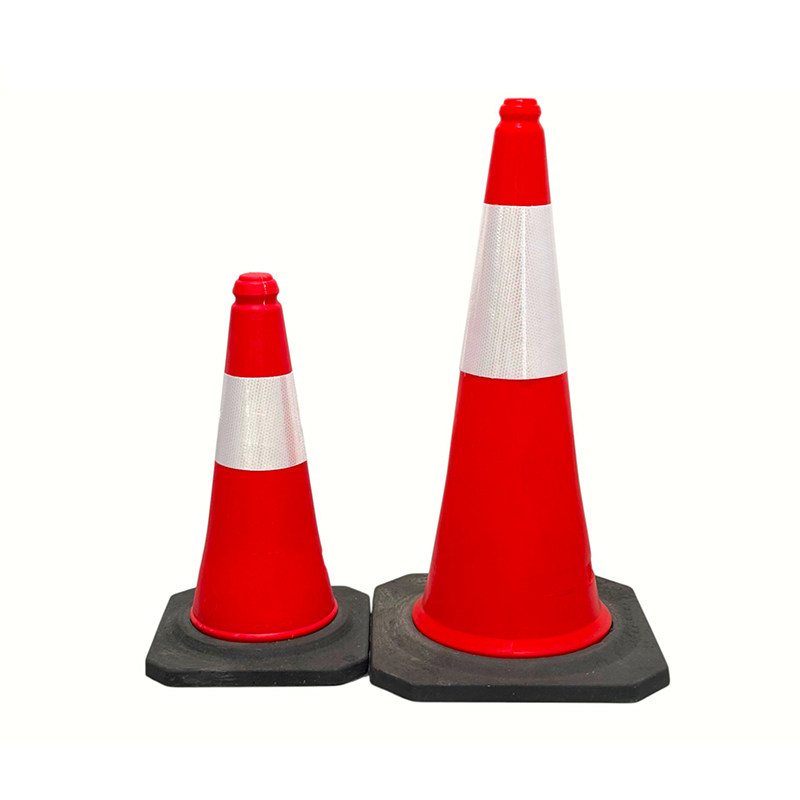
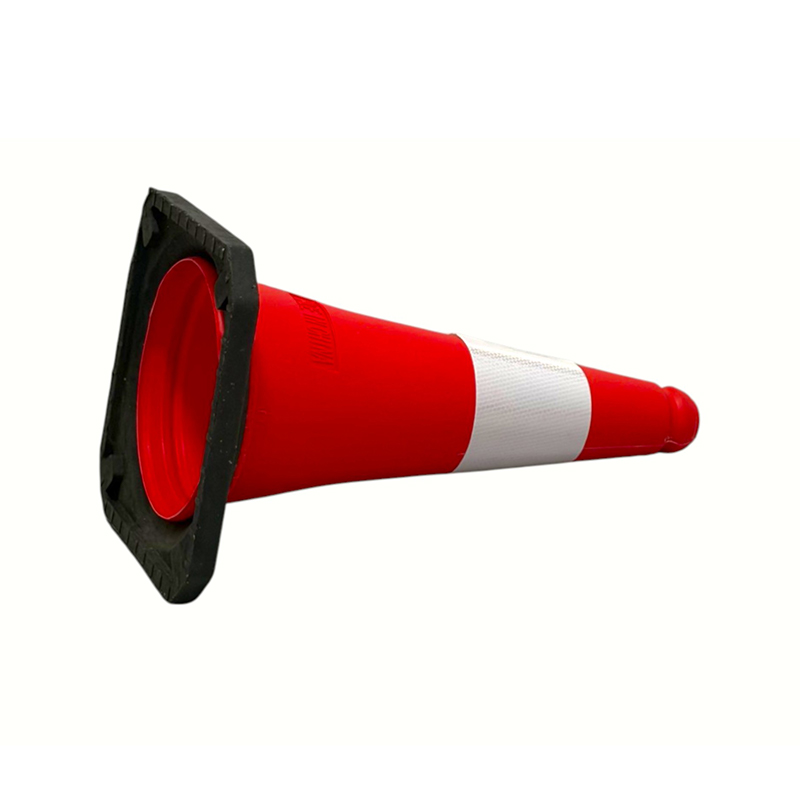 50/75/100cm High-Visibility PE Reflective Traffic Safety Cone for Road ManagementPremium Material: Manufactured from high-strength PE (Polyethylene) for exceptional compression resistance and impact toughness, ensuring long-term durability.View Product →
Key advantages
- Best balance of weight, cost, and impact resistance.
- Strong performance in freezing temperatures.
- Available in wide-body variants that resist tipping.
Limitations under truck loads
- Can permanently deform after many heavy overruns.
- May not rebound as completely as high-quality rubber.
- Thin budget cones are vulnerable at the wall.
Head-to-Head Comparison Under Truck Overruns
The table below summarizes how the three materials perform under the forces that matter on a freight site.
| Property | PVC | Rubber | PE |
|---|---|---|---|
| Crush resistance | Medium | High | Medium-High |
| Rebound after overrun | Good | Excellent | Good |
| Cold-temperature toughness | Low | High | High |
| Weight | Light | Heavy | Light |
| Typical cost | Low | High | Low-Medium |
| Best for truck overrun zones | Occasional | Daily | Frequent |
Verdict: if trucks run over a cone every day, rubber is the most durable material. If crews need a practical balance of weight, cost, and impact survival, PE is the strongest all-rounder.
Beyond Material: What Else Determines Survival?
Material chemistry sets the ceiling, but construction details decide whether a cone survives a real freight yard.
Base design
A wide base with a weighted rubber or sand-filled option increases the force needed to tip or drag the cone. A cone that stays vertical when struck by a tire edge is far less likely to be crushed.
Wall thickness
Thicker walls resist splitting and permanent denting. Budget cones are usually thin-walled and fail quickly under trucks even when the material itself is adequate.
Reflective collar integrity
After an overrun, the reflective sleeve must remain attached and free of cracks. Collars molded into the cone body survive better than collars that are glued or clipped on.
Height and taper
Taller cones give drivers a longer warning distance, but they also offer more leverage to a tire. In narrow lanes, operators often combine cones with flexible posts and bollards. For site layouts that combine multiple devices, explore our full range of traffic safety solutions.
Which Cone Should You Choose for Heavy Truck Zones?
There is no single perfect material. Rubber is the most durable pick for zones where trucks overrun cones daily, such as warehouse gate lanes and construction site entrances. PE is the best all-round material when crews need to move many cones quickly and still get strong impact survival. PVC works well for temporary traffic control and indoor use, where overruns are rare and budgets are tighter.
For many operators, the best strategy is a mixed fleet: heavy rubber cones at pinch points and impact zones, PE wide-body cones on straight stretches, and PVC cones only where they will not be run over. Our PVC versus rubber selection guide for industrial work zones explores the cost and performance trade-offs between those two materials in greater depth.
Frequently Asked Questions
Q1: Can a traffic cone survive a fully loaded semi-truck running over it?
Yes, but mainly rubber and high-elasticity PE cones can survive repeated overruns. A PVC cone may survive a single slow roll-over, but it will likely crack if the tire hits the base while turning. The key is a flexible material, thick walls, and a stable weighted base.
Q2: Are rubber cones always better than plastic cones?
Rubber is more durable under truck overruns, but it is heavier and more expensive. For crews that deploy and retrieve cones often, the weight penalty reduces productivity. PE cones offer the best compromise in most work zones.
Q3: What base design is best for preventing truck damage?
A rubber base or a hollow base that can be filled with sand or water adds mass and friction, which keeps the cone upright. When a cone stays vertical, the tire rolls over the tapered body instead of pinning it against the ground.
Choosing between PVC, rubber, and PE traffic cones is ultimately a cost-per-impact calculation. Rubber leads in raw survival, PE leads in all-round value, and PVC leads in economy. For heavy freight truck overruns, put rubber at the pinch points, PE on the main run, and reserve PVC for low-risk areas. That combination keeps your site visible, your crew safe, and your cone replacement budget under control.