

 Español
Content
- 1 What a Crash Barrier Does Before You Specify One
- 2 The Three Stiffness Classes That Drive Every Crash Barrier Spec
- 3 Why Water-Filled HDPE Crash Barriers Are a Different Species
- 4 Five-Question Checklist for Selecting Work-Zone Crash Barriers
- 5 Installation and Maintenance Realities
- 6 Crash Barrier Selection FAQs
When a contractor has to close two lanes of a rural highway for a culvert replacement, the crash barrier they pick has to do two jobs at once: redirect a fully loaded truck that drifts out of its lane, and let the crew move the entire barrier line by hand before the 6 a.m. traffic surge. That is the practical reality of crash barrier procurement. The category covers concrete Jersey walls, steel W-beam guardrails, and water-filled HDPE plastic units — devices with very different stiffness, deflection, cost, and handling characteristics. The right choice depends less on which is strongest and more on how long the job runs, how often the line has to move, and what the adjacent traffic looks like.
What a Crash Barrier Does Before You Specify One
A crash barrier is a tested roadside device that safely redirects, slows, or stops an errant vehicle and prevents a more severe collision with workers, equipment, or infrastructure. The word safely carries the real requirement: a barrier must absorb the impact without launching the vehicle back into adjacent lanes, without breaking apart on contact, and without folding into the work area.
Two performance frameworks dominate procurement. In the United States, the Manual for Assessing Safety Hardware (MASH) defines containment levels based on vehicle mass and impact speed. Europe's EN 1317 sets comparable test levels. Both classify barriers by how much they deflect under a defined impact, which is the single most useful metric for a specifier.
The Three Stiffness Classes That Drive Every Crash Barrier Spec
Every crash barrier specification begins with one decision: how much the barrier is allowed to deflect under impact. Stiffness class determines everything else — weight, installation method, cost, and reuse potential.
Rigid barriers, such as concrete Jersey and precast units, deflect almost not at all. They redirect a vehicle by mass and are the default for permanent median and bridge protection, but they need a crane and a precast plant and cannot be moved by a crew. Semi-rigid barriers, such as steel W-beam guardrail, bend and absorb energy through plastic deformation of the posts and rail. They work well on long rural sections and are the baseline for permanent roadside protection. Flexible barriers, such as water-filled HDPE units and crash attenuators, deflect substantially, reduce peak deceleration on vehicle occupants, and recover their shape after impact, which is why temporary work zones use them almost exclusively.
| Characteristic | Rigid (concrete) | Semi-rigid (steel) | Flexible (water-filled HDPE) |
|---|---|---|---|
| Typical deflection | Negligible | Moderate | High, recovers after impact |
| Weight per module | Very heavy | Moderate | Light when empty |
| Installation method | Crane | Post and rail, mechanical | Fill with water, hand placement |
| Reusable in short work zones | Rarely | Limited | Designed for repeated deployment |
Why Water-Filled HDPE Crash Barriers Are a Different Species
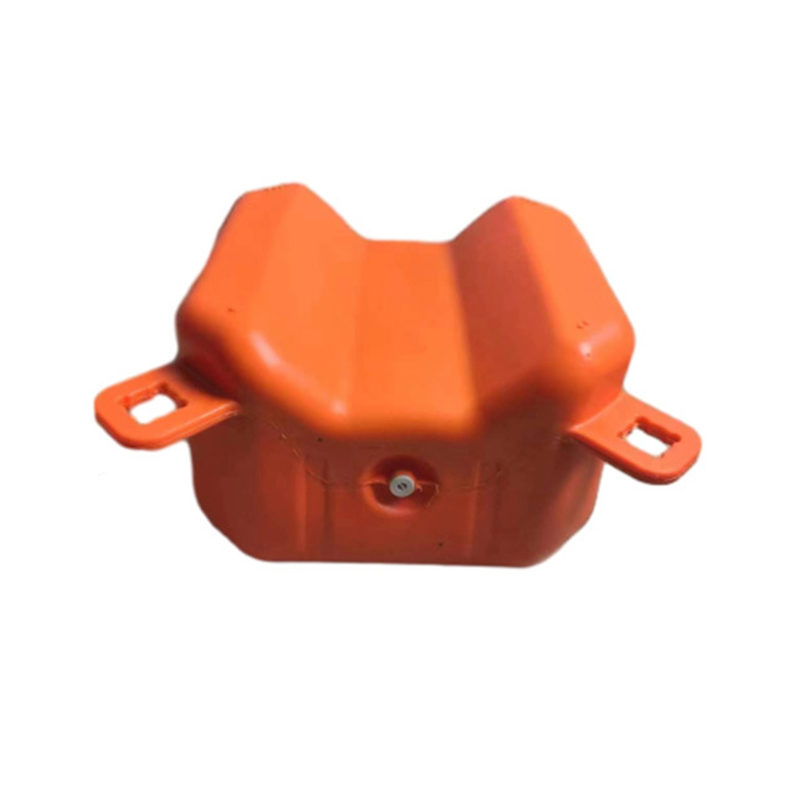
Water-filled HDPE crash barriers solve the transportability problem that makes concrete and steel impractical for short-duration work zones. The modules are blow-molded plastic shells, typically 0.8 to 2.0 meters per unit, and they are filled with water on-site for ballast and drained when the work zone moves.
An empty module weighs a small fraction of a concrete section, so a two-person crew can position or reposition units without a crane. Integral interlocking pins tie the line together, and the water ballast provides the mass that makes the assembly behave as one continuous system. Because HDPE is UV-stabilized and impact-resistant, these units survive repeated setup, impact, draining, and storage — often for several years of active work-zone duty. A heavy-duty water-filled plastic traffic barrier is a good example of a modern unit built for this cycle.
 Heavy-Duty Water-Filled Plastic Traffic Barrier for Work ZonesThis barrier combines HDPE durability with water ballast stability, enabling quick setup and repositioning by a two-person crew without heavy machinery. Its interlocking design forms a continuous system suitable for temporary lane closures.View Product →
The material choice also matters when barriers must be moved up and down grades or stored outdoors. A material comparison of steel, aluminum, and HDPE safety hardware shows that polymer systems avoid rust and are much lighter per meter, which directly reduces the number of crew hours needed to reconfigure a lane closure.
Five-Question Checklist for Selecting Work-Zone Crash Barriers
The fastest way to shortlist a crash barrier for a work zone is to answer five questions before you open a product catalog. The answers will eliminate half the market before you start.
- What is the design speed and required test level? MASH TL-3 or EN 1317 class N2 is common for high-speed highways. If the spec calls for TL-4, the barrier must handle a heavier vehicle and a faster impact, which changes what a plastic unit can deliver.
- How often does the barrier line move? Daily moves favor drainable water-filled modules; a fixed alignment for the whole job can justify heavier, cheaper units.
- What vehicles are in the adjacent lanes? A high heavy-truck mix raises the containment need and may rule out low-profile units. For work-zone transitions, the same material and impact-rating screening applies to traffic bollards and delineators — this impact-rating guide for traffic bollards covers the comparison.
- Are you protecting workers or only motorists? Worker protection usually demands a secondary lateral offset and more frequent impact testing.
- What is your handling capacity? Crew size, water source, storage area, and forklift availability determine the practical barrier length per night.
Installation and Maintenance Realities
Water-filled barriers demand more installation discipline than steel or concrete, not less. Every module must be filled with clean water to the marked level; partially filled units can slide or topple under impact and are not safe. In cold climates, deploy low-profile units or use an antifreeze additive where specified, because ice formation changes the ballast mass and the shell's behavior.
Interlocking pins must be fully seated and a secondary connector used where specified; otherwise the line behaves as separate islands rather than a continuous barrier. After any impact, inspect the shell for cracks, check the reflective sheeting for edge damage, verify that the pins still engage, and replace any module with UV-embrittled plastic.
- Cracks in the shell around the pin interlocks
- Edge damage on the reflective sheeting
- Bent or seized interlocking pins
- Signs of UV embrittlement or surface crazing
An interlocking water-filled road guardrail is the type of unit that benefits most from disciplined pin seating and water-level checks, because the full length is assembled module by module.
 Blow-Molded Interlocking Water-Filled Road GuardrailAs a modular unit, this guardrail allows disciplined pin seating and water-level checks. It offers portability when empty and stability when filled, making it ideal for assembling long barrier lines in work zones.View Product →
At the taper end of a work zone, a modular combination HDPE traffic anti-impact barrel with reflective sheeting is commonly deployed to close the transition between the barrier line and the open lane.
 Modular HDPE Traffic Anti-Impact Barrel with Reflective SheetingCommonly used at taper transitions, this barrel combines impact absorption with high visibility. Its modular design allows flexible placement and quick installation, enhancing safety where barrier lines meet open lanes.View Product →
Crash Barrier Selection FAQs
What is the difference between a crash barrier and a traffic barrier?
In most procurement documents the terms are used interchangeably, but technically a traffic barrier can be a low-profile device intended to separate lanes or protect pedestrians, while a crash barrier is tested to contain and redirect vehicles under impact. If a project document says crash barrier, assume MASH or EN 1317 testing is required.
Can water-filled HDPE barriers be used on high-speed highways?
Yes, when the unit is tested to the required MASH level. Water-filled plastic barriers are a standard option for temporary work zones across US state DOTs and European motorways, provided they are continuously interlocked, filled to the marked level, and backed by appropriate taper treatment.
What does a MASH test level mean?
MASH containment levels run from TL-1 to TL-5. TL-3 is the most common for highways carrying passenger cars and some trucks. A higher level means a heavier vehicle and a faster impact, so the barrier must offer more containment and less deflection.
How long do HDPE crash barriers last?
With proper handling and no severe impact, UV-stabilized units typically last 5 to 10 years of intermittent work-zone service. The reflective sheeting and connectors are usually replaced earlier; the shell is what gives the long service life.