

 Español
Content
- 1 What Defines a Compliant Road Construction Sign?
- 2 Material Selection for Road Construction Signs: What Survives a Work Zone
- 3 Matching Road Construction Sign Types to Work Zone Applications
- 4 Reflective Performance and Visibility Standards
- 5 Common Procurement Mistakes to Avoid
- 6 Frequently Asked Questions
At 60 mph, a driver has roughly 3.5 seconds to read, process, and react to a road construction sign. At that speed, 12-inch lettering is borderline legible, and anything smaller than 8 inches practically disappears. That is the physics behind every specification choice in work zone signage. Yet many project teams still select signs by price alone, treating "orange means warning" as the only requirement. The real question is not what a sign looks like on arrival; it is what it looks like after six months of UV exposure, wind, rain, and the occasional glancing blow from a truck mirror.
What Defines a Compliant Road Construction Sign?
At its core, a road construction sign is a portable warning device that must communicate a hazard, direct traffic, and remain visible under all lighting conditions. Everything else - size, color, reflective sheeting, base weight - supports those three functions.
Compliance is not a matter of opinion. The U.S. Manual on Uniform Traffic Control Devices (MUTCD) governs every symbol, border width, and letter height on American roadways. European projects follow the EN 12899 series, with EN 12899-3 covering temporary traffic signs. These standards set minimum dimensions, retroreflective classes, and color values.
Sizing is the most visible element of these rules. A temporary warning sign on a 50 mph road must be at least 48 inches; on a 30 mph road, 36 inches is acceptable. The same logic applies to letter height: the faster the traffic, the larger the lettering must be.
The most overlooked element is the base. A sign mounted on a lightweight PVC base tips over in the first strong gust; a heavy rubber base keeps it upright. Many field failures that look like "sign damage" are actually "base failure." This is why a compliant sign is a system, not just a plate.
Material Selection for Road Construction Signs: What Survives a Work Zone
Materials determine how long a sign remains compliant. Three materials dominate the market: aluminum, HDPE, and PVC. Each has a distinct trade-off between cost, weight, and impact resistance.
| Material | Weight | Impact Resistance | UV Durability | Primary Application |
|---|---|---|---|---|
| Aluminum | Light | Low (dents) | Excellent | Permanent and semi-permanent signs |
| HDPE | Light to medium | High (flexes back) | Excellent | Portable work zone signs |
| PVC | Very light | Low (cracks) | Good | Budget / short-duration signs |
Aluminum is the classic choice for permanent and semi-permanent signs. It is flat, rigid, accepts retroreflective film well, and does not corrode. But it is light enough to be caught by wind if not properly counterweighted. Aluminum signs also dent on impact, which makes them less suitable for close-proximity work zone placement.
 Corrosion-Resistant Aluminum Reflective Traffic Sign for Permanent InstallationsThis aluminum sign offers long-term durability and high reflectivity for permanent road guidance. Its anti-corrosion design makes it suitable for coastal or humid environments, while multiple reflective grades ensure visibility at night.View Product →
HDPE has become the preferred material for portable traffic signs. It bends on impact and rebounds, which matters in a work zone where equipment and vehicles routinely brush against signs. It is also less likely to rust or corrode. The raised square format used in many temporary signs is specifically designed to accept quick-change panel systems.
PVC is the budget option. It is affordable and easy to manufacture, but it lacks the impact resistance of HDPE. Use it for short-duration projects only.
For a deeper comparison of how these materials perform in expandable safety structures, see our material analysis of steel, aluminum, and HDPE.
Matching Road Construction Sign Types to Work Zone Applications
Different work zone scenarios require different sign formats. The classic orange diamond warning sign is the workhorse, but it is not the only tool.
Temporary warning signs are the most common. They come with quick-change panels or pre-printed faces and are designed for fast setup on short notice. A portable HDPE square extendable traffic sign with quick-change clips lets one worker swap the message panel without tools. This matters when lane configurations change daily and the sign must be re-flagged quickly. These signs are typically used in advance of the work area to warn drivers of lane closures, merges, or reduced speeds.
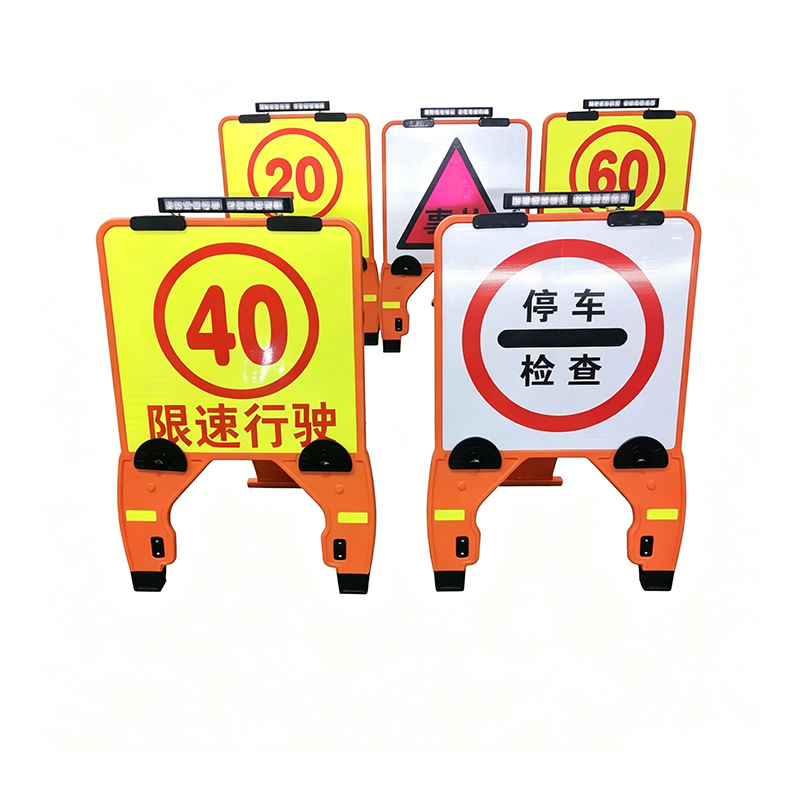 Portable HDPE Square Extendable Traffic Sign with Quick-Change ClipsDesigned for rapid deployment in work zones, this lightweight HDPE sign features a foldable design and quick-change clips, allowing one worker to swap message panels without tools, saving time during frequent lane configuration changes.View Product →
Traditional Sign Setup
Pre-printed panels, bolts or screws, heavy base, requires a second person to reposition.
Quick-Change System
Interchangeable message panels, tool-free clips, lightweight HDPE base, one-worker operation.
Delineation signs and bollards mark the path around the work area, not just the hazard. They use reflective bands or panels to catch headlights and guide traffic through curves, lane shifts, and taper zones. A flexible traffic delineator sign board with an impact-resistant elastic base bends and rebounds when struck, preventing the sign itself from becoming a secondary hazard. Delineators are placed at intervals along the taper, so drivers always know where the edge of the work zone is.
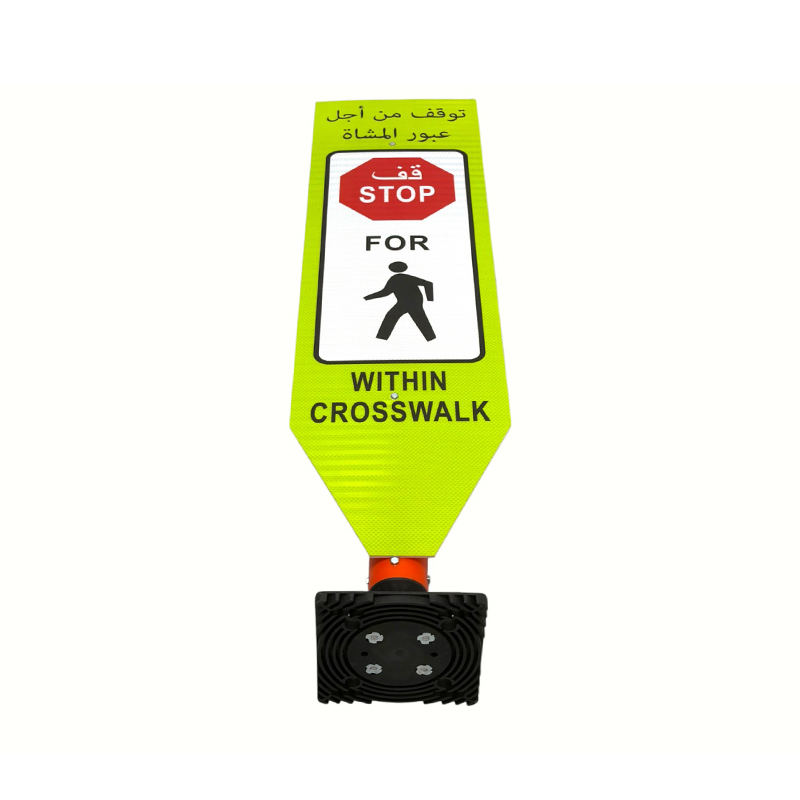 Flexible Traffic Delineator Board with Impact-Resistant Elastic BaseThis delineator uses a resilient base that rebounds after impact, reducing secondary hazards. Its high-intensity reflective film enhances night visibility, making it ideal for marking work zone edges and lane shifts in high-traffic areas.View Product →
Barricade signs and warning lights mark the start and end of the work zone. They signal the actual boundary and make the zone visible at night.
Reflective Performance and Visibility Standards
Reflective sheeting separates a sign that works from a sign that disappears. Three retroreflective categories dominate the market:
- Engineering Grade (Type I) uses enclosed-lens glass beads. It is rated for 3-7 years of outdoor life and is the baseline for low-speed and daytime work zones. It is the least expensive option and the most common on municipal projects.
- High-Intensity Prismatic (Type III) uses a micro-prism structure to return light more efficiently. It offers roughly 3 times the retroreflectivity of engineering grade and is the minimum recommendation for high-speed roadways. It is the standard choice for highway work zones.
- Diamond Grade (Type IV) delivers up to 10 times the reflectivity of engineering grade. It is specified for critical high-speed applications where sign failure is unacceptable. It is also the most expensive.
Before the brake pedal is even touched, the car has already covered 220 feet. A sign with insufficient reflectivity shortens this window.
For work zones on roads with speed limits above 40 mph, high-intensity prismatic or better is the practical baseline. This is not just an aesthetic preference; it is a matter of stopping distance. A sign with insufficient reflectivity cuts the visible distance below the threshold a driver needs to react.
Common Procurement Mistakes to Avoid
Most problems with road construction signs are not caused by the sign face. They are caused by the system around it. Here are the five most common procurement mistakes:
- Ignoring base weight. A lightweight base may save money today and cost far more in replacement or liability tomorrow.
- Mixing reflective grades. Engineering grade on one section and high-intensity on another creates inconsistent visibility. This is a safety gap, not a cosmetic issue.
- Buying for price instead of duration. A PVC sign that survives 30 days is a bargain on a 30-day project. On a 6-month project, it is a hidden cost that shows up as replacement orders.
- Neglecting the mounting interface. Quick-change clips, flexible mounts, and interlocking bases make a sign easier to reposition and less likely to fail at the joint. A broken hinge can make an otherwise good sign unusable.
- Not accounting for local weather. UV degrades plastic, rain enters mounting holes, and wind can carry a lightweight sign. Choose materials rated for your climate zone and expected exposure time.
Frequently Asked Questions
What size road construction sign should I use?
For a 50 mph road, MUTCD requires at least a 48-inch temporary warning sign. For lower speeds (30 mph and below), 36-inch signs are acceptable. European standards follow similar speed-based sizing.
What is the minimum reflective grade for highway work zone signs?
High-intensity prismatic (Type III) is the practical minimum for speed limits above 40 mph. Engineering Grade (Type I) should be reserved for low-speed or daytime-only applications.
Are HDPE signs better than aluminum for work zones?
For portable temporary signs, yes. HDPE bends and recovers on impact, while aluminum dents. For permanent installations, aluminum remains the better choice because of its rigidity and flat surface.
How long will a road construction sign stay compliant?
It depends on the reflective grade and UV exposure. Engineering Grade lasts 3-7 years; High-Intensity Prismatic lasts 7-12 years. Replacement is needed when the sign face loses its retroreflectivity or becomes deformed.